Digital Media

Bachelor’s
4
Student-Led Media Platforms
The Vision (magazine). The Vision Online (website). WNGR ‘The Vibe’ (radio). And Vision-48 News (television). Four incredible programs – countless opportunities to master your craft.
14
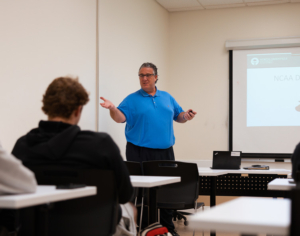
Average Class Size
Collaborate with your peers and network with your professors. Connect to countless resources and career opportunities, thanks to NGU’s smaller class sizes.
7
Electives
Digital Media Advertising and Marketing. Freelance Writing. Mass Media Management. Opinion Writing. Public Relations Campaigns and Cases. Sports Writing. And Writing for Public Relations.

Be the Future of Media

Pursuing a career in digital media opens the door into in the ever-evolving landscape of technology and communication. With a focus on using digital platforms and multimedia tools, you can create compelling content, engage audiences, and shape the digital space by working as a broadcaster, photographer, writer, editor, or a media manager.

Whether in fields such as social media management, digital marketing, or interactive design, your expertise in digital media enables you to reach global audiences and create meaningful connections. Use the power of digital storytelling as you master contemporary digital technology, innovate, and make a lasting impact.

Choose from one of the following concentrations:

Why Choose?

  • Degree Flexibility. With a media degree, the possibilities are endless. You can explore diverse and fulfilling careers that allow you to express your creativity and shape stories.
  • Gain Practical Experience. Experience every aspect as a VisionTV staff member. Recognized by the SC Press Association as a leader in online student media, NGU’s VisionTV and VisionMedia are led by students who manage studio operations and field production.
  • Create a Professional Portfolio. We’ll help you professionally showcase your talent and work to best highlight your achievements.

Program Overview

  • Why NGU?

    At North Greenville University, you will grow academically and spiritually to become the transformational leader God has uniquely called you to be. All courses are taught from a Christ-centered perspective, integrating faith and learning. Wherever you are, NGU is here to help you reach your academic and professional goals.

  • Purpose

    To obtain experience in the contemporary media landscape and expand your career potential by creating a professional portfolio of skills and work.

Get to Know Our Faculty!

Web Drake, PhD
Dean, College of Communication and Fine Arts
Randall E. King, PhD
Associate Dean, School of Communication
Heather Kunselman
Academic Secretary
Kelechi Benet, MFA
Assistant Professor, Communication
Lara Jackson, MS
Instructor, Communication
Karyn Campbell, PhD
Assistant Professor, Communication
Zack Carter, PhD
Associate Professor, Communication
Shurajit Gopal, PhD
Assistant Professor, Communication
Andrew W. Stevens, DMin
Associate Professor, Communication
Ansley Welchel, APR
Instructor, Communication

Study Digital Media in Every Form

Digital Media Year 1

Year 1 Example Courses

  • Composition and Rhetoric
  • Introduction to Mass Communication
  • Christian Worldview
  • Media Technology
  • Information Science
Digital Media Year 2

Year 2 Sample Courses

  • Oral Communication
  • Writing for Digital Media
  • English Literature
  • Photojournalism
  • Digital Imagery
Digital Media Year 3

Year 3 Sample Courses

  • Multimedia Production
  • Practicum
  • Graphic Communication
  • Advanced News Writing and Copy Editing
  • Media Audience Research
Digital Media Year 4

Year 4 Sample Courses

  • Mass Media Law and Regulations
  • Multimedia Design
  • Social Media Management
  • Principles of Public Relations
  • Mass Media Ethics

Have Questions about the Digital Media Program?

profile unknown

Randall E. King, PhD

Associate Dean, School of Communication
864.663.0200 randall.king@ngu.edu
© North Greenville University. All Rights Reserved. | Accessibility Statement

North Greenville University (NGU) admits students of any race, color, national and ethnic origin to all the rights, privileges programs, and activities generally accorded or made available to students at the school. It does not discriminate on the basis of race, color, national and ethnic origin in the administration of its educational policies, admissions policies, scholarship and loan programs, and athletic and other school-administered programs.